Featured

Ethical Essentials: Post #2

The building blocks of Quality Family Planning and Reproductive Healthcare Equity

Relativity applies to physics, not ethics

— Albert Einstein.

Autonomy and respect for persons is based on the concept that “individuals have the right to their own beliefs and values and to the decisions and choices that further these beliefs and values” (Longest, 2016).  Quality family planning can uphold this principle by following a person-centered approach that not only solicits the values of the person being served, but takes these preferences seriously and supports the individuals progress towards self-determination by providing accurate information and a full range of options for care to enable the person to obtain the care they desire.  

In a vulnerable population, individuals may be a greater risk of the opposite force, paternalism, which is when someone else determines what is best for people (Longest, 2016).  Clear efforts must be made to protect people from paternalism and promote autonomy and self-determination. “Person-centered” family planning is founded on this core ethical principles. Family planning programs tailored to women suffering from or in recovery from substance use disorders would do well to model their practices on this evidence-based framework that priorities ethics and the person’s experience of care over the relatively arbitrary outcome of contraception uptake or contraception type chosen.

Justice is another critical ethical principle germane to the topic of reproductive health equity for women in recovery.  Justice in this context refers to achieving the fair distribution of reproductive health-related benefits.  Services should be provided on the basis of need and the burdens an costs should be on those who endanger the public health (Longest, 2016).

Women in recovery have well documented needs and desires for quality reproductive healthcare (Black & Day, 2016).  Currently, many barriers exist for this population to access care to which they are entitled. Integration of reproductive healthcare into programs that directly serve this population can reduce these barriers and more fairly distribute reproductive healthcare (Black & Day, 2016).

It would follow ethical principles to require “those who endanger the public health” to assume some of the burden of funding new integrated programs. Allocating portions of settlement funds from major companies found to have profited from and contributed to the opioid crises is a partial remedy to consider. Purdue Pharma, Johnson & Johnson, Endo International, and Allergan are all healthcare giants that are currently considering large financial settlements to resolve opioid suits (Mann, Dwyer, & Castele, 2019)

Nonmaleficence is the ethical concept that our efforts must seek to do no harm (Longest, 2016).  To avoid harm in family planning we must be cautious to avoid coercion and intentional in how we measure our “success” to ensure our measurements reflect our values (Dehlendorf, Bellanca, & Policar, 2015).   Currently the Office of Population Affairs (OPA) collects data on two outcome measurements related to contraceptive care: “most & moderately effective method” use and “access to long acting reversible contraception (LARC).”    It is important for programs and providers to understand that the OPA intentionally does not set benchmarks for these measures and does not expect the former to reach 100% nor the latter to be used to promote LARCs above all other options.  It is inappropriate and unethical to use these outcomes in a pay-for-performance context as this could lead to coericion (USDHHS & OPA, 2020).

Beneficence is the ethical principle that actions are taken on the basis of seeking to do good with kindness and charity to maximize the benefits to society as a whole and balance the benefits and burdens (Longest, 2016).  The OPA recognizes that a complimentary measurement is needed to monitor program “successes” based on the patient-reported, client experience of care with contraceptive services.  Efforts have been made to develop validated scales to measure this (Dehlendorf, Henderson, Vittinghoff, Steinauer, Hessler, 2018).  Consideration could be given to tying this type of measurement to pay-for-performance measures at it would reinforce the person-centered, ethical principles of care. In this way, quality family planning does good by empowering women to have the information and support they need to make decisions for themselves and enable them to received care they desire. This type of support has been described in the literature as “joint decision making” and more recently as “shared decision making” (Dehlendorf, Grumbach, Schmittdiel, & Steinauer, 2017).

References

Dehlendorf, C., Bellanca, H., & Policar, M. (2015). Performance measures for contraceptive care: What are we actually trying to measure? Contraception; 91(6):433-437.

Dehlendorf C., Grumbach, K., Schmittdiel, J.A., & Steinauer, J. (2017). Shared decision making in contraceptive counseling. Contraception. PMID: 28069491.

Dehlendorf, C., Henderson, J.T., Vittinghoff, E., Steinauer, J., & Hessler, D. (2018). Development of a patient-reported measure of the interpersonal quality of family planning care. Contraception; 97:34–40. PMID:28935217.

Mann, B., Dwyer, D., & Castele, N. (2019, Aug 28). Not just Purdue: Big drug companies considering settlements to resolve opioid suits. Retrieved from https://www.npr.org/2019/08/28/755007841/several-big-drug-companies-considering-massive-settlements-to-resolve-opioid-sui?t=1580131657883

Power to Decide. (2018, July). Access is power: Opioid use disorder and reproductive health.  Retrieved from https://powertodecide.org/system/files/resources/primary-download/Opioid%20Use%20Disorder%20and %20Reproductive%20Health%20.pdf

U.S. Department of Health & Human Services, Office of Population Affairs. (2020).  Performance measures.  Retrieved from https://www.hhs.gov/opa/performance-measures/index.html
Finance and Sustainability Issues for Family Planning

Medicaid and the Affordable Care Act

According to the National Family Planning & Reproductive Health Association, Medicaid is the cornerstone for publicly funded family planning.  Medicaid has required states to cover family planning services and supplies since 1972.  Since the 1980s, it has been the leading source of public funding for family planning.  The importance of Medicaid’s coverage for family planning has grown further with expanded eligibility under the Affordable Care Act (ACA). The expansion enabled 15.5 million people to gain coverage since 2013.  Medicaid is required to offer the full range of contraceptive methods, must have at least one option for each contraceptive category.  Benefits are provided in partnership with funding from states.  The federal government covers about 90% of the cost.  Medicaid-funded family planning is exempt from individual cost sharing, meaning individuals do not need to pay co-pays or deductibles for family planning care.  Protecting full federal support for Medicaid and the ACA expansion is critical to sustaining family planning services for people with low-incomes.

https://www.aha.org/system/files/media/file/2019/04/fact-sheet-340b-0419.pdf

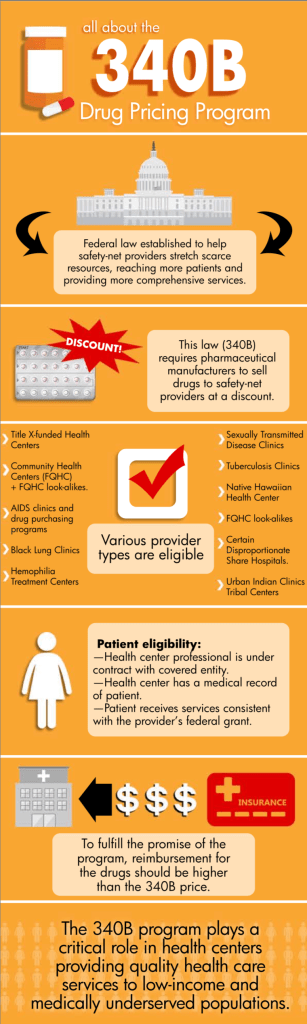
The 340B Drug Pricing Program 

This program is part of the Public Health Services Act and was initiated over 25 years ago.  It controls the costs of contraceptive medications and implants by requiring pharmaceutical manufacturers who participate in Medicaid to sell outpatient drugs at discounted prices to health care organizations including community health centers, hospitals, and rural referral centers.  Organizations can use the 340B program to save on costs and enable the organizations to afford to care for uninsured patients.  According to the Health Resources and Services Administration (HRSA), organizations can save and average of 25-50% on pharmaceutical purchases.  The program has a proven record of decreasing government spending at the same time as it increases access to care for millions.

Sadly, despite this, some are pushing to scale back this program.  This program needs protecting as it is essential to helping providers stretch limited resources to better serve their vulnerable patients.  The American Hospital Association is one group that is taking a position to defend this program and expand the program to include investor-owned hospitals that provide care for the underserved.

Coding and Billing

The National Family Planning and Reproductive Health Association has created a practical solutions manual with example case studies and useful tools to help providers adapt to the changes created by the Affordable Care Act.  It includes an online resource directory and billing and coding training to support providers to be able to sustain their work by being reimbursed fairly for services provided. Coding and Billing correctly for services is an important part of communicating the value of what has been provided to the patient.

Technology, Innovation, & Family Planning

Like no other time in history, telehealth is being used to offer services during the COVID-19 pandemic.  Rapid change of practice in response to physical distancing recommendations has resulted in increasing numbers of practices and hospitals turning to telehealth to safely care for patients.

Policy changes have been made at unprecedented speeds to allow for the accommodations needed. Recently, Medicare announced it would support telehealth by expanding reimbursement for office, hospital and other telehealth visits in the U.S.  This is a landmark change as, prior to this, Medicare was only reimbursing in limited telehealth situations such as patients living in rural areas.  Now patients can stay at home and schedule virtual visits with their provider and avoid potentially exposing others or themselves to infection.  President Trump discussed the expanded telehealth options and commented that users “are loving it.”(1)  He went on to project that it may change the way the country functions medically in the future.  

Family planning options have existed online and via telehealth prior to the pandemic, but may now be experiencing an uptick in usage.  Traditional practices are also now adjusting their practices to enable counselling and prescribing birth control remotely.  While family planning will always need some face to face care as certain methods can only be placed or removed by a provider, increasing options regarding how women access family planning may have lasting changes even in more traditional settings.

Currently, birth control can be delivered directly to a person’s home via mail-order services.  Some require standardized health questionnaires to be filled out online, while others use video visits with a provider. Technologies to support these services include videoconferencing, the internet, store-and-forward imaging, streaming media, and terrestrial and wireless communications (2).   Telehealth has to potential to improve patient access and experience, reduce costs, and address staffing shortages (2).  

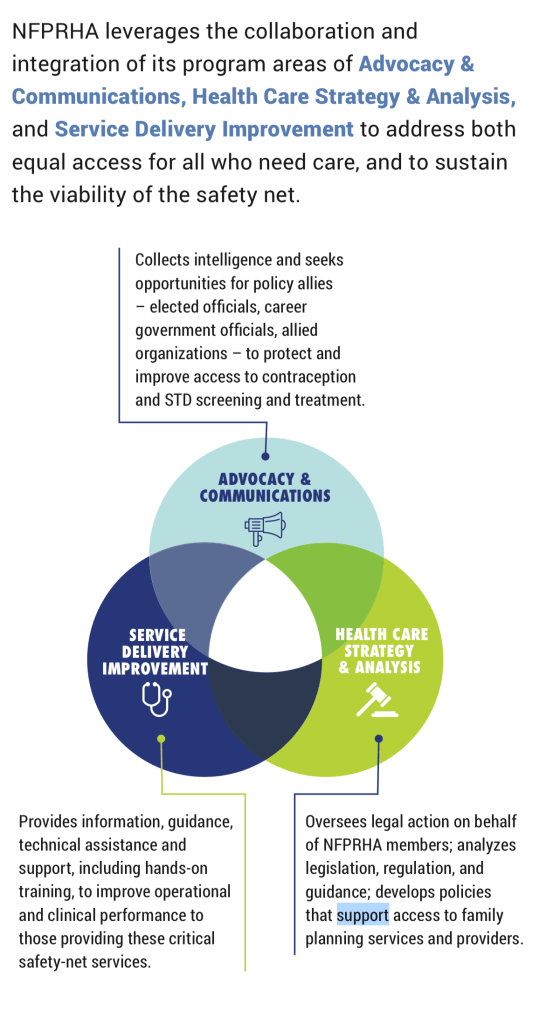
The National Family Planning and Reproductive Health Association (NFPRHA) provides resources and technical assistance regarding telehealth needs assessment, implementation, and policy and regulation.  NFPRHA also provides a forum for information sharing among provider/members who are interesting in telehealth family planning.  

Bedsider, is a non-profit user-friendly online resource for sexual health and family planning.  It lists some of the innovative programs offering telehealth family planning to women.  Bedsider is widely endorsed by health care providers and has helpful information and resources for both providers and patients.  Bedsider provides an easy to use search engine to find traditional health centers, telehealth, home delivery, and emergency contraception by zip code.

Here are some of the innovative companies providing remote family planning:

Þ   28H – Twentyeight Health

Þ   HeyDoctor

Þ   Nurx

Þ   Pandia Health

Þ   The Pill Club

Þ   PillPack

Þ   Simple Health

References

  1. White House.  Remarks by President Trump, Vice President Pence, and Members of the Coronavirus Task Force in Press Briefing. (2020)  Retrieved from   https://www.whitehouse.gov/briefings-statements/remarks-president-trum-vice-president-pence-members-coronavirus-task-force-press-briefing-4/.  
  2. National Family Planning and Reproductive Health Association.  (2019).  Health Care and Technology.  Retrieved from https://www.nationalfamilyplanning.org/pages/issues/issues—providing-high-quality-services—health-care-and-technology
  3. Bedsider. How to get birth control delivered right to your door. (2019). https://www.bedsider.org/features/851-how-to-get-birth-control-delivered-right-to-your-door

Private Sector Work

https://powertodecide.org

Private organizations can be strong leaders of policy change.  Power to Decide is a non-profit organization active in advocating for policies that support a woman’s “right to determine if, when, and under what circumstances she would like to become pregnant. Power to Decide stands for equity, stating 

“To us this means the promise that everyone gets exactly the information and access to care they need to achieve healthy outcomes—no matter their ultimate decision. They get it on their terms, from someone who understands and respects them.”

Tara Mancini, the Senior Manager of Public Policy for Power to Decide refers to the non-profit’s mission statement

I had the opportunity to interview Tara Mancini, the Senior Manager of Public Policy for Power to Decide.  She shared with me the importance of representing all women with reproductive autonomy policies, regardless of their race, wealth, health, or “place in society”.

She shared that she was unaware of any policies specifically related to birth control for women with substance use disorders. In fact, we discussed it may be an improper goal-as targeting certain groups may violate ethics.  However, she shared that women with SUDs can benefit from the global work of promoting reproductive autonomy and access to quality information and care for all women. Tara shared how they are working on public policy to promote one of their key initiatives, One Key Question® (OKQ).  OKQ is a tool that can be used with all women to guide conversations about reproduction and pregnancy desires. 

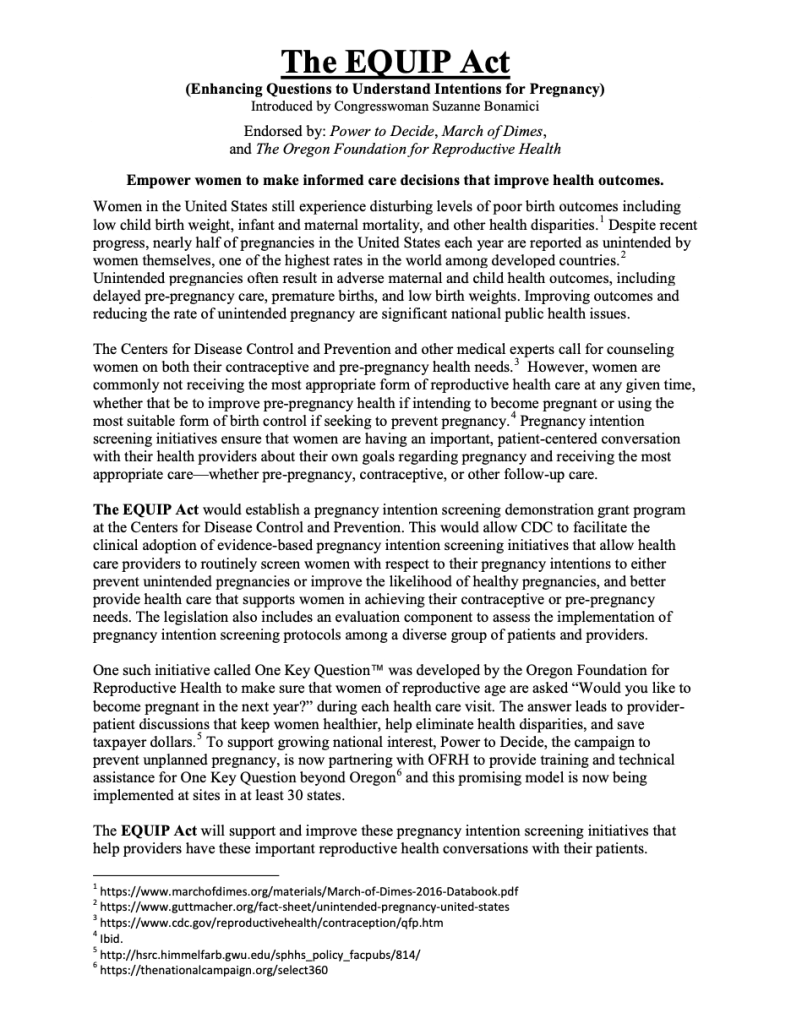
Tara discussed the importance of collaborative alliances and gathering strength from working with others with similar goals.  She shared with me information about the EQUIP (Enhancing Questions to Understand Intentions for Pregnancy) Act that was first introduced in the 115th Congress by Congresswoman Suzanne Bonamici.  The Act was officially endorsed by Power to Decide, the March of Dimes, and the Oregon Foundation for Reproductive Health, an example of non-profit private organizations with overlapping goals working together in policy making.  

The EQUIP Act is a bill written to gain support for efforts to reduce unintended pregnancy through federal investments and grants to study the effectiveness of pregnancy intention screening programs in different settings.  Tara shared how Power to Decide, the March of Dimes, and the Oregon Foundation for Reproductive Health worked with Congresswoman Bonamici to ensure the language of the act was evidence-based and avoided potential pitfalls like coercion or funds going to places that might not take family planning seriously.  Some of the language included was specifically intended to protect the autonomy of vulnerable populations, such as women in recovery. 

Here is an excerpt of some the protective language that was included:

          “(C) Consideration of health disparities among the population served.

                      “(D) Assessment of the equitable and voluntary application of such initiatives to minority and medically underserved communities.

                      “(E) Assessment of the training, capacity, and ongoing technical assistance needed for providers to effectively implement such pregnancy intention screening protocols.”

Section of the EQUIP Act

A press release by Congresswoman Bonamici summarizes the act below:

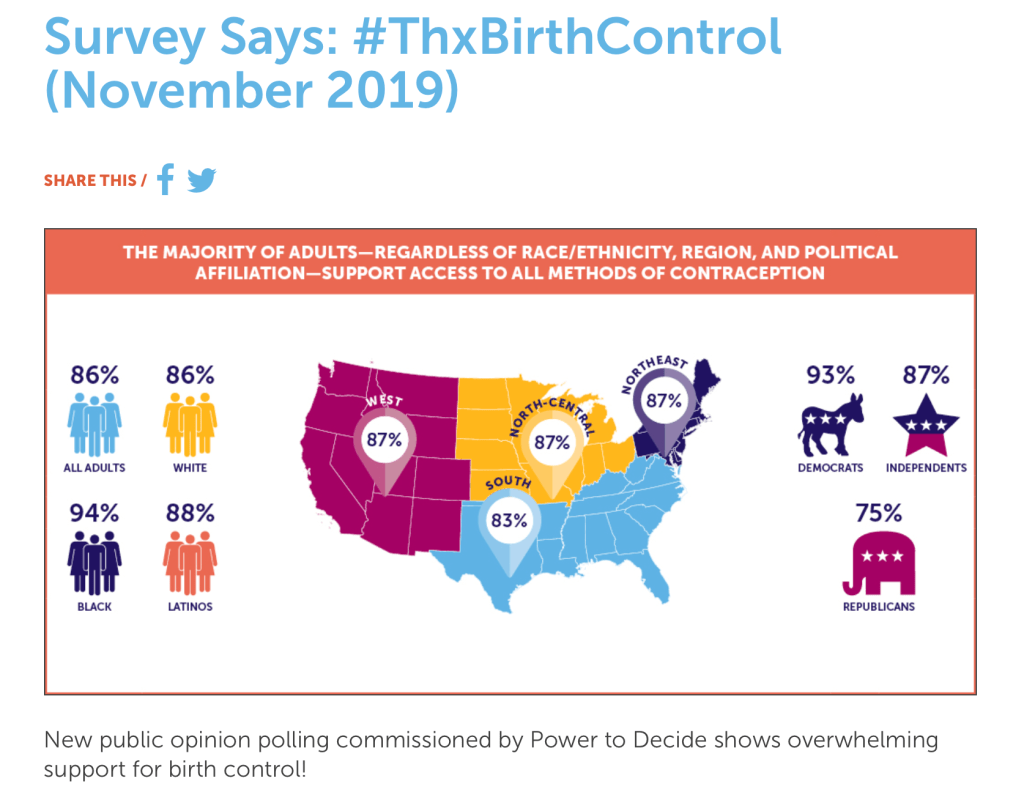
Tara informed me that Power to Decide also influences policy making by conducting and reporting public opinion surveys to inform policymakers of the desires of their constituents.  Last November Power to Decide conducted a survey regarding access to birth control.  Sharing these results can help policymakers vote in favor of policies that promote access to birth control.

The Historical and Contemporary Role of Institutions and Actors and Pertinent Statutes: Addressing Unintended Pregnancy among Women with Substance Use Disorders

Illustration: Chiara Ghigliazza for The Intercept https://theintercept.com/2020/02/10/louisiana-abortion-supreme-court-third-party-standing/

Demonization of women who use substances while pregnant has resulted in law enforcement policies that may have caused further harm.  In the 1980s, during the “crack-cocaine” crisis, the U.S. government shifted drug control efforts from health to criminal justice in what was called the “War on Drugs.” Some of the resulting policies led to women being incarcerated, forcibly detained in treatment facilities, or losing their children.  The fear of facing these punitive measures can discourage women from seeking care (Bishop et al., 2017).  When laws fail to consider the underlying reasons for substance use disorders, unintended consequences can negatively affect overall health including reproductive autonomy. 

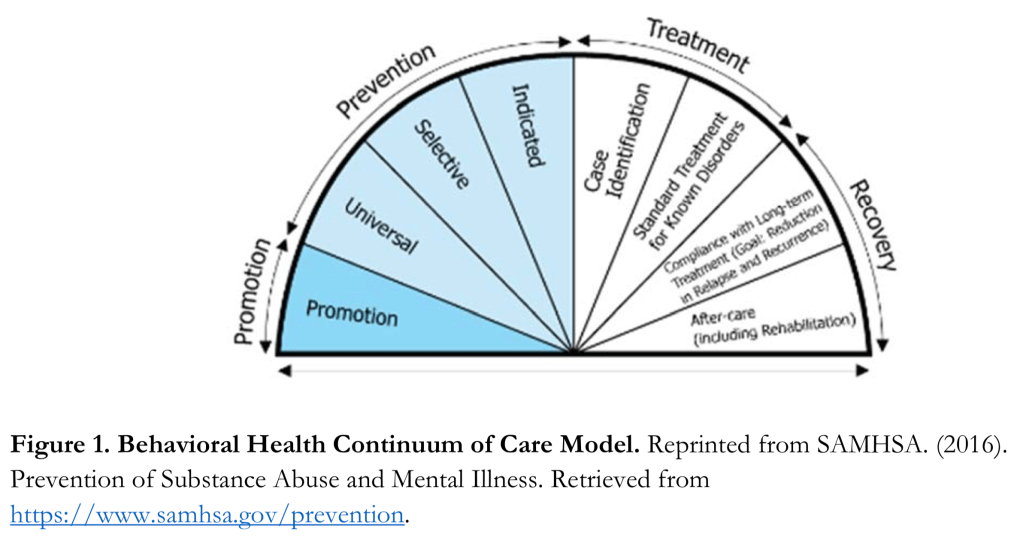
A public health approach works to encourage and assist women to gain access to needed treatment and care.  The public health focus favors harm reduction over punishment.   Public health also focuses on prevention.  Such strategies include access to substance use treatment for women of reproductive age and women-focused services in recovery programs.  One government agency that works toward this goal is the Substance Abuse and Mental Health Services Administration (SAMHSA). According to SAMHSA, approximately 8% of Americans have a substance use disorder (SUD). SAMHSA’s Behavioral Health Continuum of Care Model promotes a more holistic view for addressing substance use from a mental illness perspective.

Fortunately, there are current efforts to address the opioid-related crisis that have learned from past policies and are focusing more on treatment instead of punishment. However, while the large majority of SUD programs accept women as clients, only a minority offer programs designed for women despite research showing that women are more likely to enroll and remain in programs that are women-centered (Bishop et al., 2017).

While women with SUDs struggle to find programs tailored for them, another force is acting against their reproductive equity. The battle for reproductive autonomy and access to quality family planning is affecting all women in our nation. Title X is a United States Department of Health and Human Services (USDHHS) funding program that provides family planning grants to health departments, public and non-profit agencies and community centers (USDHHS, 2019) that has suffered regulation changes swayed by the Trump administration (Kingdom, 2011; Sonfield, 2018). Title X is an example of regulation change that has come from the conservative attempts to restrict reproductive autonomy, particularly abortion. In doing so, access to pregnancy prevention and preconception health care will also be restricted.

Power to Decide is a private, non-profit agency that promotes a person’s right to determine if when and under what circumstances they would like to become pregnant. Power to Decide is an active voice in policy-maker ears to support women’s reproductive autonomy. Power to Decide projects more “family planning” deserts will arise as a consequence of the Title X changes.

A map of contraceptive deserts in the US without Title X

In order to reduce unintended pregnancies or to improve the health of desired pregnancies among women in recovery from substance use disorders, we need policies that make it easier for women with substance use disorders to access family planning, not more difficult. Policies and programs are needed to promote more women-focused SUD programs that provide integrated, holistic services.

Exchange of accurate scientific and clinical information between researchers and policy-makers has the potential to ensure that policies are grounded in the best available evidence. Making the connection between policy and science is critical if we are to promote women’s health through improved access to high-quality healthcare.

Jacobs Institute of Women’s Health Bridging the Divide (Bishop et al., 2017)

References

Kingdon, J.W. (2011). Agendas, alternatives, and public policies.(2nd ed.). Glenview, IL: Pearson Education Inc.

Sonfield, A. (2018). Trump administration revives Title X ‘domestic gag rule’. Contraceptive Technology Update, 39(8).

US Department of Health and Human Services (2019). Compliance with statutory program integrity requirements: Title X program guidance. Retrieved from https://www.hhs.gov/opa/title-x-family-planning/about-title-x-grants/statutes-and-regulations/compliance-with-statutory-program-integrity-requirements/index.html

Introduction

I am creating this blog while pursuing a doctor of nursing practice degree and studying to become a women’s health nurse practitioner. The topic is important to me because I have spent the past 20 years working as a nurse caring for women and their families. I have seen firsthand the profound joy and profound complications that pregnancy can bring to women’s lives. Women need quality health information and care to support their pregnancy intentions. However, the United States has a problem: our country has high levels of unintended pregnancies; but certain groups of women have disproportionately high rates of pregnancy (Black & Day, 2016).

My recent work has been with women in one of Arizona’s largest substance use recovery programs. I had an opportunity to ask a new residential client One Key Question,

“Would you like to become pregnant in the next year?”

One Key Question is a registered trademarked program of Power to Decide

Her response tells a story that gets to the heart of the problem:

“No one has ever asked me that before, not once. And it’s so important as I know so many women who have had babies only to have them taken away and that makes recovery so much hard… there’s no pain like that”

anonymous 32 year old women in recovery

She had been in 18 different treatment programs over her lifetime.

In our siloed care, we are missing opportunities to connect services with people who need them.

The outcomes are devastating:

Approximately 86% of pregnancies among substance-using women are unintended compared to approximately half of pregnancies among women in the general population (Black & Day, 2016).

Women with substance use disorders experience significant physical and psychosocial risks during pregnancy (Black & Day, 2016).

The incidence of newborn withdrawal, referred to as neonatal abstinence syndrome (NAS) has increased nearly fivefold over that past decade (Patrick & Schiff, 2018).

NAS costs an estimated 1.5 billion dollars in hospital charges each year (Patrick & Schiff, 2018).

Why is this conversation important?

  • Because women in recovery need more support to prevent unintended pregnancies, prepare for desired pregnancies, and receive basic reproductive healthcare.
  • Because currently folks that are trying to support women in recovery are often disconnected from others trying to support women in recovery.
  • Building connections has the power to improve the lives of women in recovery and our communities.

The goal of this blog is to explore ways to create innovative polices or strengthen existing policies to better support women in recovery to receive the care they desire to determine their reproductive future. Policy making is about people… clearly identifying the problem people are experiencing, connecting with people who have expertise with people who have the power to affect change with funding and policymaking (Patton, Zalon, & Ludwick, 2019).

Work has begun. Key expert groups working on this issue are:

  • The World Health Organization
  • The Center for Disease Control and Prevention
  • The American College of Obstetricians and Gynecologists
  • The American Academy of Pediatrics
  • The American Public Health Association
  • Substance Abuse and Mental Health Services Administration
  • American Society of Addiction Medicine

Current legislative position:

Action is needed. Currently no legislation mandates recovery programs to integrate reproductive health services or screening with substance use treatment. However, a few programs have begun co-locating family planning with SUD recovery programs. Women find these programs acceptable and even preferable to traditional separated services (Robinowitz et al., 2016). These innovative integrated programs have managed to reduce barriers and are making promising strides (Black & Day, 2016). Coalition building with leaders in women’s health, addiction health, and legislation is needed to build on these fledgling successes and create effective guidelines and policies for further implementation efforts. Health policy enables improvement beyond the individual patient, it serves to organize, deliver, and ensure compensation for quality health services across systems, states, or nations (Longest, 2010). It is with policy changes that we can make a real impact to reduce unintended pregnancy rates for women in recovery.

References

ACOG Committee on Health Care for Underserved Women, American Society of Addiction Medicine.  (2012).  ACOG Committee opinion no. 524: Opioid abuse, dependence, and addiction in pregnancy.  Obstetrics and Gynecology, 119, 1070-1076.

ACOG Committee on Gynecologic Practice, Long-Acting Reversible Contraception Working Group.  (2018).  ACOG Committee opinion no. 642: Increase access to contraceptive implants and intrauterine devices to reduce unintended pregnancy.  Obstetrics and Gynecology, 126, e44-48.

Black, K.I., & Day, C.A. (2016).  Improving access to long-acting contraceptive methods and reducing unplanned pregnancy among women with substance use disorders.  Substance Abuse: Research and Treatment, 10(S1), 27-33.

Ko, J.Y., Wolicki, S., Barfield, W.D., Patrick, S.W., Broussard, C.S., Yonkers, K.A., Naimon, R., & Iskander, J. (2017).  CDC grand rounds: Public health strategies to prevent neonatal abstinence syndrome.  MMWR: Morbidity and Mortality Weekly Report, 66(9), 242-245.

Longest, B.B. Jr. (2010). Health policymaking in the United States. (5th ed.). Chicago, IL: Health Administration Press.

Patrick, S.W., & Schiff, D.M. (2018).  A public health response to opioid use in pregnancy.  Pediatrics, 139(3),1-7.

Patton, R.M., Zalon, M.L., & Ludwick R. (2019). Identifying a problem and analyzing a policy issue. In R.M. Patton, M.L. Zalon, & R. Ludwick (Eds.), Nurses making policy: From bedside to boardroom (2nd ed.) (pp. 103-128). New York, NY: Springer Publishing Company.

Robinowitz, N., Muqueeth, S., Scheibler, J., Salisbury-Afshar, E., & Terplan, M.  (2016). Family planning in substance use disorder treatment centers: Opportunities and challenges. Substance Use and Misuse, 51(11), 1477-1483.U.S. Department of Health and Human Services (2020). Title X family planning. Retrieved from https://www.hhs.gov/opa/title-x-family-planning/index.html

Design a site like this with WordPress.com
Get started